
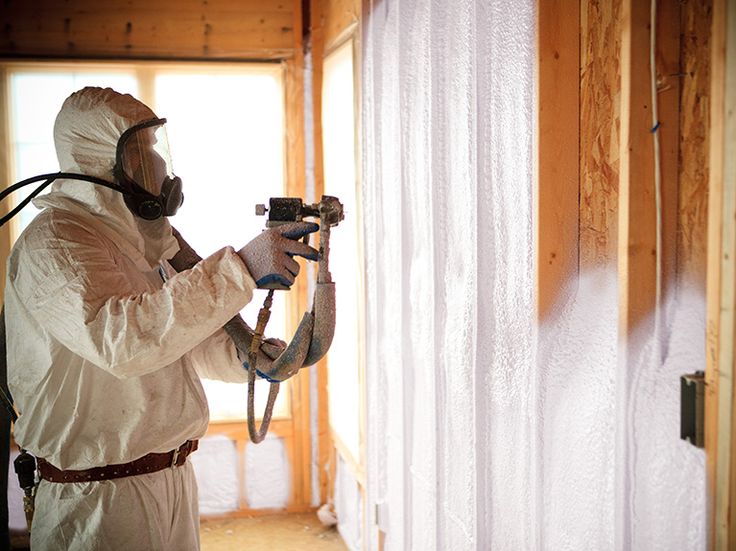
Spray polyurethane insulation is engineered to deliver seamless thermal protection, air sealing, and structural reinforcement for buildings and industrial environments. Applied as a liquid that expands into a rigid, closed-cell foam, it forms a continuous insulation layer that eliminates joints, gaps, and thermal bridges, ensuring superior energy efficiency and environmental control.
At Ambica Engineers, our spray insulation systems are designed for precise application, strong substrate adhesion, and consistent density formation, enabling long-term insulation performance across roofs, walls, cold storage, tanks, and specialized structures.
We work closely with clients to provide insulation solutions tailored to temperature control, moisture resistance, and energy-saving requirements, ensuring uniform coverage and dependable results across every project.
Expands to form a joint-free barrier that eliminates air leakage and thermal bridging for enhanced energy efficiency.
Delivers excellent insulation performance, helping maintain stable internal temperatures while reducing energy consumption.
Bonds effectively to concrete, metal, wood, and masonry surfaces, ensuring long-lasting stability without mechanical fastening.
Closed-cell structure minimizes water absorption and prevents condensation, protecting structures from corrosion and dampness.
Adds rigidity without adding load, making it suitable for roofing systems, tanks, and industrial enclosures.
Spray process enables quick installation over complex geometries, ensuring consistent insulation even in hard-to-reach areas.
Ambica Engineers delivers high-performance spray polyurethane insulation systems engineered for superior thermal sealing, structural reinforcement, and long-term energy efficiency across industrial, commercial, and infrastructure applications. Our insulation is applied through controlled spray processes that ensure uniform density, seamless coverage, and strong substrate adhesion, resulting in consistent performance without joints or thermal gaps.
We work closely with consultants, contractors, and facility owners to translate project requirements into reliable insulation solutions tailored to operating conditions. From surface preparation and calibrated application to protective finishing, our focus is on delivering insulation systems that enhance durability, environmental control, and lifecycle performance.
Experienced in polyurethane engineering and manufacturing.
Manufactured using carefully selected raw materials.
Focused on understanding application-specific requirements.
Spray polyurethane foam (SPF) creates a seamless, closed-cell insulation layer that eliminates joints, a major source of thermal loss in board-type materials like EPS or mineral wool. Its in-situ expansion ensures full surface adhesion, preventing air infiltration, vapor migration, and thermal bridging. With significantly lower thermal conductivity and no mechanical fastening gaps, SPF typically delivers 30–40% higher effective thermal efficiency over the lifecycle of the system.
Yes. Closed-cell SPF has very low water absorption (<2% by volume) and functions simultaneously as insulation, air barrier, and vapor retarder. This makes it highly effective in environments prone to condensation, such as cold storages, dairy plants, or pre-engineered buildings. Unlike fibrous insulation, it does not sag, retain moisture, or promote microbial growth, ensuring long-term dimensional stability and corrosion protection for metal substrates.
Performance depends primarily on density control, proper substrate preparation, and calibrated spray application. When applied at the correct density and thickness, SPF maintains structural integrity and R-value for decades because it does not settle or delaminate. Protective UV coatings or screeds are added in exposed areas to prevent surface degradation, allowing systems to achieve service lives exceeding 20–25 years with minimal maintenance.

We bring innovation and precision to every PUF foam project, delivering reliable solutions that ensure long-lasting performance and efficiency.